
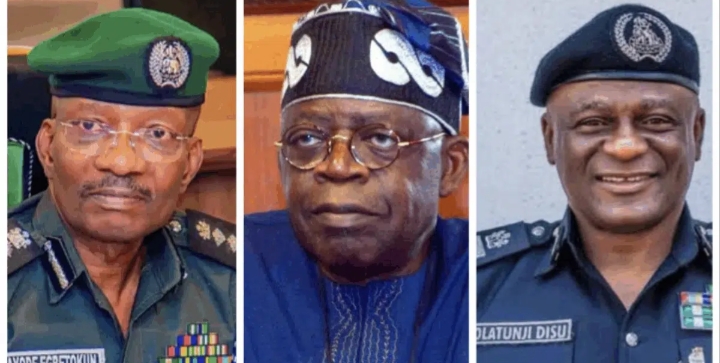
Why Tinubu Removed Egbetokun: Funding Gaps, Controversial Postings and Promotion Disputes Surface

Fresh details have emerged regarding the exit of former Inspector-General of Police, Kayode Egbetokun, with security and administrative concerns said to be central to the decision.
Multiple sources familiar with developments disclosed that President Bola Tinubu became increasingly concerned over the deteriorating security situation across several states, including Kaduna, Niger, Kwara, Zamfara, Kebbi and Adamawa, where incidents of kidnappings, armed attacks and killings had surged.
According to insiders, an internal assessment allegedly revealed that some state police commands had not received their operational and logistics allocations for up to six or seven months. The reported funding shortfall was said to have severely limited mobility, intelligence gathering and rapid response capabilities at command level.
Security sources indicated that the development unsettled the Presidency, prompting a directive for Egbetokun to proceed on retirement.
Another issue said to have strained relations within the top hierarchy involved the redeployment of Assistant Inspector-General of Police, Tunji Disu.
Disu, who had overseen the Special Protection Unit (SPU) and was reportedly tasked with coordinating the withdrawal of police personnel from VIPs, was removed from the unit and replaced by an officer considered close to the former IGP.
Sources claim the Presidency intervened, directing that Disu be reinstated to the SPU, while the officer who replaced him was placed on administrative leave. However, Disu was later redeployed to the Force Criminal Investigation Department (FCID) in Lagos; a move that reportedly intensified tensions.
Egbetokun’s tenure was also reportedly clouded by internal dissatisfaction over special promotions. Senior officers alleged that some personnel were elevated multiple times within a short span without meeting established requirements such as examinations, years of service or other professional benchmarks.
The situation, insiders said, affected morale and disrupted traditional merit-based career progression within the Force.
Meanwhile, developments following Egbetokun’s departure have sparked fresh maneuvering within the police hierarchy. Reports indicate that several senior officers; including Deputy Inspectors-General (DIGs) and Assistant Inspectors-General (AIGs) who are senior to Disu; have begun lobbying the Presidency, National Assembly and the Police Service Commission in a bid to retain their positions under the new leadership.
Disu, who joined the Nigeria Police Force in May 1992, was appointed Acting Inspector-General last week and was subsequently confirmed as the 23rd Indigenous Inspector-General during a Police Council meeting held on March 2, 2026, in line with provisions of the Police Act 2020. His nomination is expected to be forwarded to the Senate for ratification.
Egbetokun had assumed office as the 22nd IGP on June 19, 2023, succeeding Alkali Baba, whose tenure ended following an extension approved under former President Muhammadu Buhari.
As developments continue to unfold, attention remains focused on whether the leadership transition will address internal grievances and restore operational efficiency amid Nigeria’s evolving security challenges.