
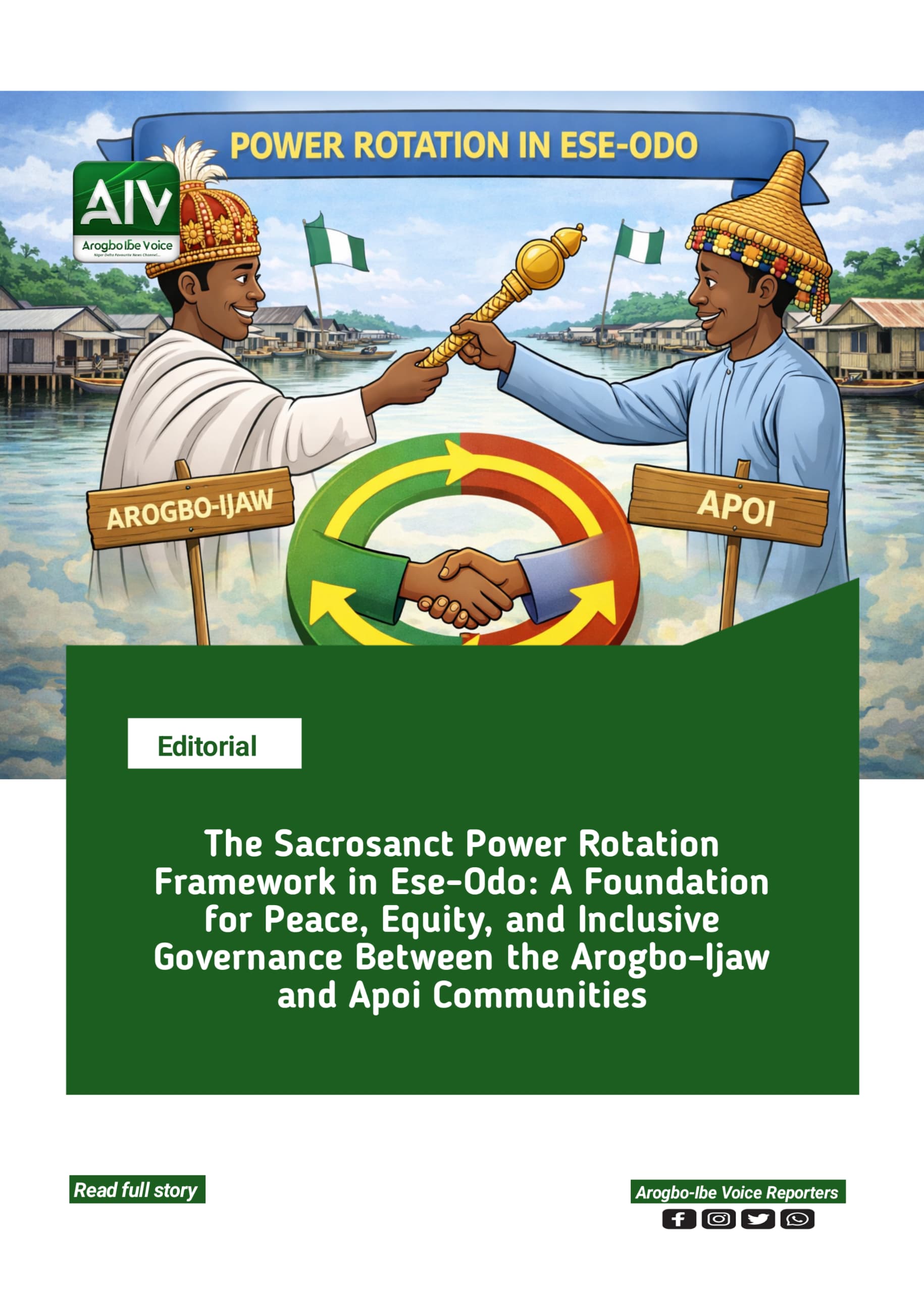
The Sacrosanct Power Rotation Framework in Ese-Odo: A Foundation for Peace, Equity, and Inclusive Governance Between the Arogbo-Ijaw and Apoi Communities

In the riverine enclave of Ese-Odo Local Government Area in Ondo State, Nigeria, two distinct Ijaw subgroups, the Arogbo-Ijaw (under the Agadagba of Arogbo-Ibe Kingdom) and the Apoi (under the Kalasuwe of the Western Apoi Kingdom), coexist within a single political constituency. Despite shared linguistic and cultural roots as Ijaw (Izon) peoples, they maintain separate traditional institutions, identities, and historical narratives. The Ondo State House of Assembly seat for Ese-Odo Constituency, along with the Ese-Odo Local Government Area chairmanship, operates under a time-honoured, unwritten but inviolable covenant: power rotates every four years between the Arogbo-Ijaw and Apoi. When it is one group’s turn, only aspirants from that group contest; the other refrains in deference to equity, brotherhood, and communal harmony.
This arrangement is not a casual political expedient but a sacrosanct pact forged from wisdom and necessity. It has endured through democratic cycles, military interruptions, and the complexities of resource-sharing in an oil-bearing coastal zone. A historical review of the constituency’s representatives in the Ondo State House of Assembly reveals its consistent application, particularly in the Fourth Republic, while earlier terms reflect foundational representation amid national political upheavals. The list, with ethnic affiliations drawn from community records and public profiles, is as follows:
1. Chief Richard A. Jolowo (1979-1983) – Arogbo-Ijaw, Pioneer member and Speaker during the Second Republic following Ondo State’s creation.
2. Hon. Sunday E. Yayu (October – December 1983) – Arogbo-Ijaw, Brief service in the aborted Third Republic.
3. Hon. Duerimini Isaac Kekemeke (1992-1993) – Arogbo-Ijaw, Term during the short-lived Third Republic transition.
4. Abiodun Anifowose (1999-2003) – Apoi, Commencement of observed rotation in the modern democratic era.
5. Kingsley Kuku (2003-2007) – Arogbo-Ijaw, From Arogbo extraction; later gained national prominence as Special Adviser on Niger Delta Affairs and Chairman of the Presidential Amnesty Programme.
6. Kele Bolodeoku (2007-2011) – Apoi.
7. Ebi Lubi (2011–2015) – Arogbo-Ijaw.
8. Vincent Obadiah (2015-2019) – Apoi.
9. Chief Success Torhukerhijo (2019–2023) – Arogbo-Ijaw, Tenure strongly endorsed by Arogbo-Ijaw organisations.
10. Hon. (Primate) Allen Messiah Oluwatoyin (2023–present) – Apoi. Current member (10th Assembly), serving as Deputy Parliamentary Secretary.
The pattern is unmistakable: terms 1-3 (Arogbo), 4 (Apoi), 5 (Arogbo), 6 (Apoi), 7 (Arogbo), 8 (Apoi), 9 (Arogbo), 10 (Apoi). This alternation unbroken in recent decades – transcends party lines and underscores the covenant’s resilience.
With the incumbent from the Apoi (2023–2027), the 2027 election must return the seat to the Arogbo-Ijaw, with only Arogbo aspirants contesting.
The sacrosanct status of this arrangement derives from its proven efficacy in averting domination, nurturing mutual respect, and preserving peace in a constituency where ethnic distinctions, traditional authorities, and resource dynamics could otherwise breed tension. It mirrors Nigeria’s federal character principle at the grassroots, embodying zoning as a mechanism for inclusive governance and balanced development.
A breach, such as permitting an aspirant from the non-turn group in 2027, would rupture this covenant with grave consequences. Nigeria’s history abounds with zoning violations igniting protests, electoral violence, boycotts, litigation, and communal clashes. In Ese-Odo’s sensitive riverine environment, such disruption could escalate into inter-group disturbances, polling disruptions, security breakdowns, and economic paralysis in an oil-producing zone. It would revive marginalisation grievances, undermine traditional rulers, and shift focus from progress to conflict.
This arrangement must not be breached for these compelling reasons:
1. Safeguarding Communal Peace – It has sustained harmony for generations in a shared space vulnerable to resource or boundary frictions.
2. Ensuring Equitable Representation – Both groups secure fair access to legislative influence, constituency projects, and advocacy.
3. Respecting Traditional Institutions – It honours the Agadagba and Kalasuwe, whose moral authority anchors the pact.
4. Preventing Marginalisation Narratives – It averts escalation of sensitivities around representation and cultural heritage.
5. Promoting Balanced Development – Alternating turns enable targeted attention to each group’s priorities, such as coastal infrastructure and host-community benefits.
6. Aligning with Democratic Norms – It reinforces zoning as a tool for inclusion, consistent with Ondo State and national practices.
7. Minimising Electoral Acrimony – Uncontested turns reduce violence, litigation, and voter intimidation.
8. Strengthening Unity Against External Pressures – Internal solidarity is vital amid state-level politics or economic challenges.
9. Guaranteeing Long-Term Sustainability – Upholding it now secures the covenant for future cycles and models equity elsewhere.
10. Honouring Cultural and Ancestral Values – As an indigenous agreement rooted in riverine ethos of collective survival and brotherhood, breaching it would disrespect shared moral foundations.
In conclusion, the historical succession of Ese-Odo’s House of Assembly members, with its clear rotation (Arogbo-Ijaw for terms 1–3, 5, 7, 9; Apoi for 4, 6, 8, 10), affirms the profound wisdom of this arrangement. From Chief Success Torhukerhijo (Arogbo-Ijaw, 2019-2023) to Hon. Allen Messiah Oluwatoyin (Apoi, 2023-2027), the next cycle belongs unequivocally to the Arogbo-Ijaw. Political parties, aspirants, traditional rulers, community leaders, and the Ondo State Government bear a collective duty to uphold this sacrosanct covenant without deviation. By honouring it, the Arogbo-Ijaw and Apoi peoples will continue to exemplify peaceful coexistence, equitable progress, and enduring unity, securing a stable and prosperous future for Ese-Odo beyond 2027.