
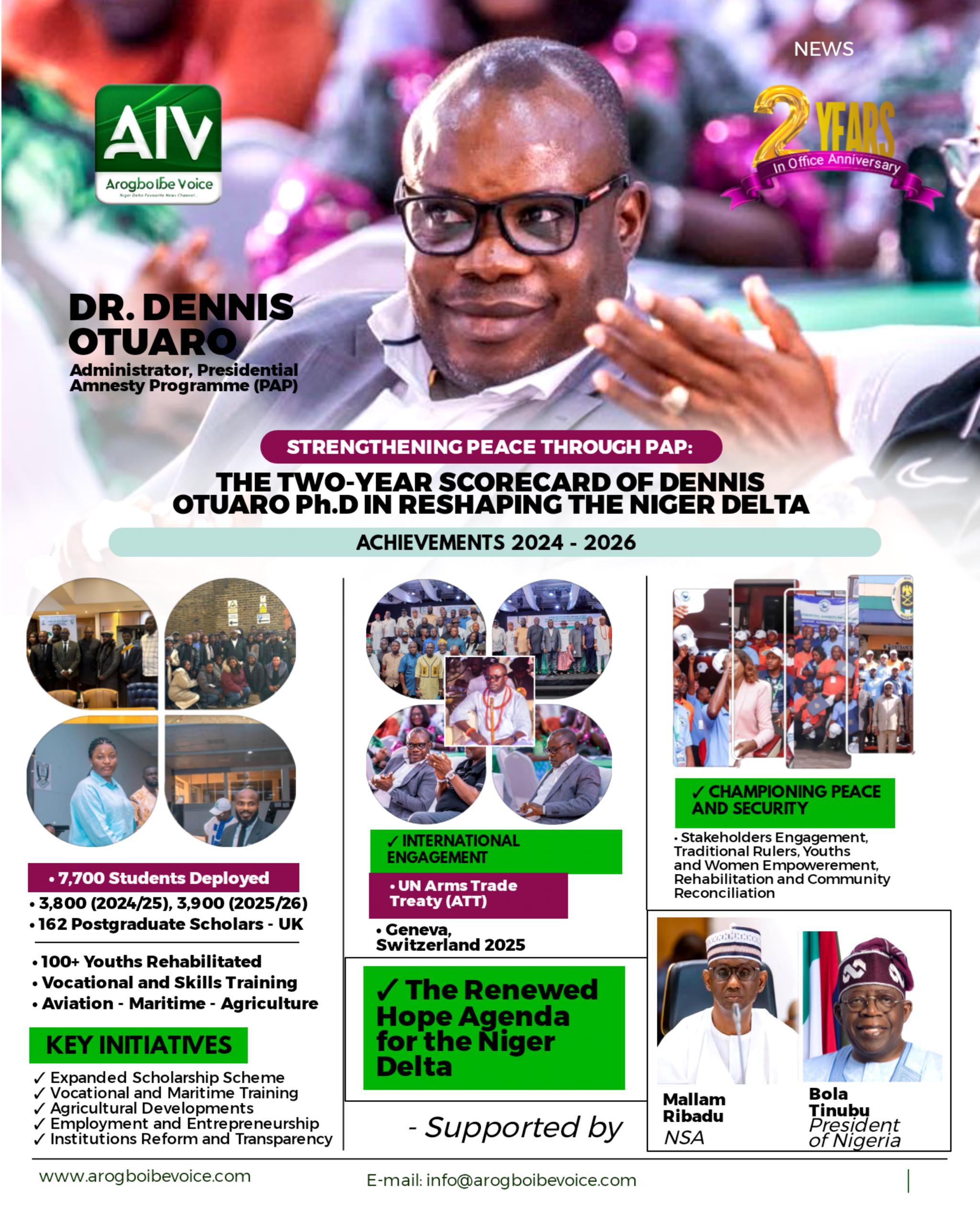
Strengthening Peace Through PAP: The Two-Year Scorecard of Dennis Otuaro Ph.D in Reshaping the NIger Delta

As the Presidential Amnesty Programme (PAP) marks two years under the visionary leadership of Chief Dennis Brutu Otuaro Ph.D, the Niger Delta is witnessing a remarkable wave of transformation. Through education, strategic engagement, and sustainable peace-building, the programme is evolving from its traditional focus on rehabilitation and reintegration into a broader platform for youth empowerment, human capital development, and socio-economic stability in Nigeria’s oil-producing region.
Since his appointment on March 14, 2024, by President Bola Ahmed Tinubu, Dr. Otuaro has pursued a deliberate strategy anchored on the belief that lasting peace in the Niger Delta can only be achieved through opportunity, inclusion, and education rather than force alone. Tinubu’s bold decision to appoint a Niger Delta indigene, fondly described as a “creek boy”, to this critical role demonstrates a deep understanding of the region’s dynamics and a commitment to inclusive leadership.
With strong support from the Office of the National Security Adviser, led by Mallam Nuhu Ribadu, the Amnesty Programme has expanded its reach, implementing reforms aimed at repositioning it as a catalyst for long-term development across the Niger Delta.
Education: A Pillar for Lasting Peace
A hallmark of Dr. Otuaro’s leadership has been the expansion of the PAP scholarship scheme. Recognizing that education remains the most effective pathway to sustainable peace, the Administrator has ensured that young Niger Deltans are given opportunities to pursue higher education both locally and internationally.
Within two years, the programme has facilitated the deployment of approximately 7,700 students to tertiary institutions across Nigeria, including:
3,800 students during the 2024/2025 academic session
3,900 students during the 2025/2026 academic session
Beyond local placements, over 160 students have secured postgraduate opportunities in the United Kingdom, gaining exposure to global academic standards and advanced research environments. For many beneficiaries, these scholarships have become life-changing opportunities, opening pathways for contributions in sectors such as logistics, agriculture, business management, and technology upon their return.
Transparency has also remained a core principle of the scholarship initiative. PAP beneficiaries are consistently reminded that these fully funded opportunities must remain free from exploitation, thereby safeguarding the integrity of the programme and maintaining the trust of Niger Delta communities.
Human Capital Development Beyond Scholarships
While education remains central, the programme’s focus extends beyond academic training. Under Dr. Otuaro’s leadership, PAP has significantly expanded vocational training, skills acquisition, and professional development initiatives.
Hundreds of youths have received training in sectors such as aviation, maritime operations, agriculture, and specialized vocational trades, equipping them with practical skills essential for self-reliance and entrepreneurship.
In the maritime sector alone, dozens of trainees have completed certification programmes, while others have acquired aviation-related qualifications preparing them for careers in Nigeria’s growing aviation industry. These initiatives are steadily building a strong manpower base capable of supporting the region’s economic transformation.
Strategic Job Placement and Professional Integration
Under Dr. Otuaro’s tenure, the programme has successfully facilitated employment opportunities for graduates of PAP-sponsored schemes across sectors such as healthcare, aviation, logistics, and engineering.
These placements reinforce the programme’s core objective of reintegration through economic empowerment, helping to prevent a relapse into militancy while strengthening community stability.
Rehabilitation and Social Stability
Recognizing that insecurity in the Niger Delta often stems from deeper social challenges such as substance abuse, the programme has expanded its rehabilitation initiatives. More than 100 youths have benefited from counselling and rehabilitation programmes, particularly those struggling with drug dependency and related behavioural challenges.
These interventions provide critical psychosocial support, helping beneficiaries rebuild their lives and reintegrate into society as productive citizens.
A Leadership Style Rooted in Consultation
Dr. Otuaro’s leadership approach is deeply consultative. Early in his administration, he visited several universities partnering with the Amnesty Programme to engage directly with students and identify ways to strengthen institutional collaboration.
This inclusive engagement extends to:
Former agitators
Youth groups
Traditional rulers
Women organizations
Community leaders
Regional stakeholders
Such consultations have been instrumental in rebuilding trust and ensuring that the Amnesty Programme reflects the collective aspirations of Niger Delta communities.
Strengthening Regional Unity Through Stakeholder Engagement
Stakeholder summits organized under Dr. Otuaro’s leadership have further promoted dialogue and collaboration. Notable gatherings include:
The Peace, Security, and Development Summit, which brought together former agitators, community leaders, and policy experts to explore sustainable peace strategies.
The Niger Delta Women Empowerment Summit, which highlighted the critical role of women in regional development and emphasized increased female participation in economic and leadership opportunities.
Traditional institutions have also been actively engaged, with royal fathers across the Niger Delta expressing strong support for initiatives aimed at sustaining peace and advancing development.
Strengthening National and International Engagement
Dr. Otuaro has also represented Nigeria in international forums on security and peacebuilding. In 2025, he participated in the Eleventh Conference of States Parties to the Arms Trade Treaty in Geneva, Switzerland, reflecting Nigeria’s commitment to global cooperation in addressing security challenges.
Such engagements underscore the country’s proactive approach to integrating domestic peace initiatives with international security frameworks.
Clearing Institutional Challenges and Strengthening Accountability
Internally, the programme has introduced reforms designed to improve transparency, reduce financial liabilities, and streamline scholarship and training processes. These reforms have strengthened public confidence in the Amnesty Programme as a credible instrument for peacebuilding and regional development.
A Strategic Vision for the Niger Delta
Perhaps the most enduring legacy of Dr. Otuaro’s leadership lies in his effort to redefine the long-term vision of the Presidential Amnesty Programme. Rather than focusing solely on stipends and reintegration, the programme now emphasises:
Education
Vocational competence
Youth empowerment
Community engagement
Regional stability
This strategy aligns with national development priorities while addressing the unique historical and socio-economic realities of the Niger Delta.
Two Years On: A Legacy Still in Progress
Two years into his administration, Chief (Dr.) Dennis Brutu Otuaro’s leadership has become synonymous with a strategy that links education, empowerment, and peace-building.
While challenges remain, the initiatives undertaken so far reflect a determined effort to reposition the Presidential Amnesty Programme as a driver of sustainable development rather than merely a post-conflict intervention.
For communities across the Niger Delta, the expectation is clear: the foundations being laid today through education, skills development, and inclusive engagement will continue to strengthen peace and unlock new opportunities for future generations.
In retrospect, President Bola Ahmed Tinubu’s decision to appoint a Niger Delta leader to head the programme appears both strategic and visionary. With continued support from the National Security Adviser, Mallam Nuhu Ribadu, the federal government’s commitment to a stable, empowered, and peaceful Niger Delta remains evident.
The transformative journey continues, and under the leadership of Chief (Dr.) Dennis Brutu Otuaro, the Niger Delta is steadily advancing toward lasting peace, inclusive development, and renewed hope.
