
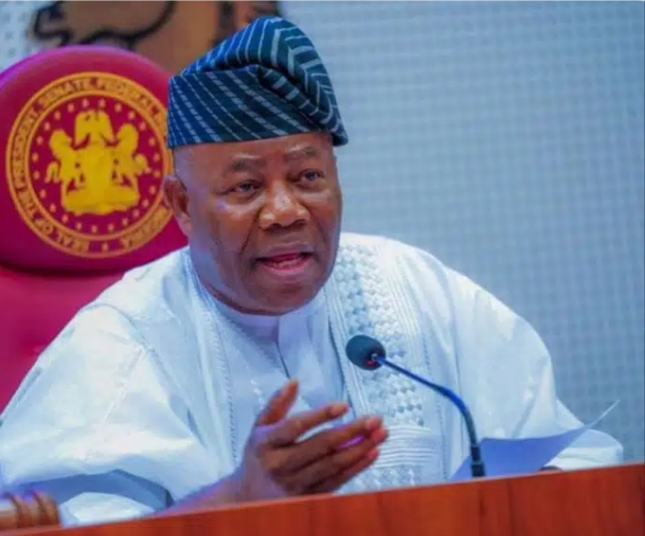

The Senate has suspended open discussion on the United States air attacks carried out on December 25 on suspected terrorist hideouts in Sokoto State.
The decision was taken during Wednesday’s plenary after Senate President, Godswill Akpabio, ruled that the matter should be handled privately due to its sensitive security implications.
Akpabio explained that issues relating to national security are not usually debated in open sessions of the chamber. He added that the Senate’s rights had not been violated, noting that lawmakers were earlier informed that the operation was carried out with the knowledge and cooperation of Nigerian security agencies.
According to him, sensitive security matters require caution and should not be extensively discussed in public.
The Senate President commended the senator who raised the issue and assured members that a full explanation would be provided during a closed-door session. He said the private briefing would help clarify issues surrounding the airstrikes and address concerns raised by lawmakers.
Akpabio urged senators to remain calm and avoid making public statements that could negatively affect national security. Following his ruling, further debate on the matter was suspended pending the closed session.
The development followed a motion raised by Senator Abdul Ningi, who represents Bauchi Central Senatorial District. Ningi brought the issue under Order 9, alleging that the reported airstrikes amounted to a breach of Nigeria’s constitutional authority.
He argued that the powers of the National Assembly are clearly outlined in the Legislative Houses (Powers and Privileges) Act and the 1999 Constitution (as amended), stressing that the responsibility for lawmaking rests with the Senate and the House of Representatives to ensure peace, order and good governance.
The lawmaker expressed concern over reports that the US military carried out attacks within Nigeria, describing such actions as an infringement on the country’s sovereignty and a violation of international rules.
Ningi further stated that the Constitution vests the authority to approve military actions in the President, as Commander-in-Chief of the Armed Forces. He added that even the President cannot lawfully permit foreign forces to operate on Nigerian soil without proper engagement with the legislature and coordination with local security agencies.
He insisted that the executive arm must be transparent with the National Assembly on security operations involving foreign countries, warning that sidelining lawmakers could weaken Nigeria’s sovereignty and create future constitutional challenges.
