
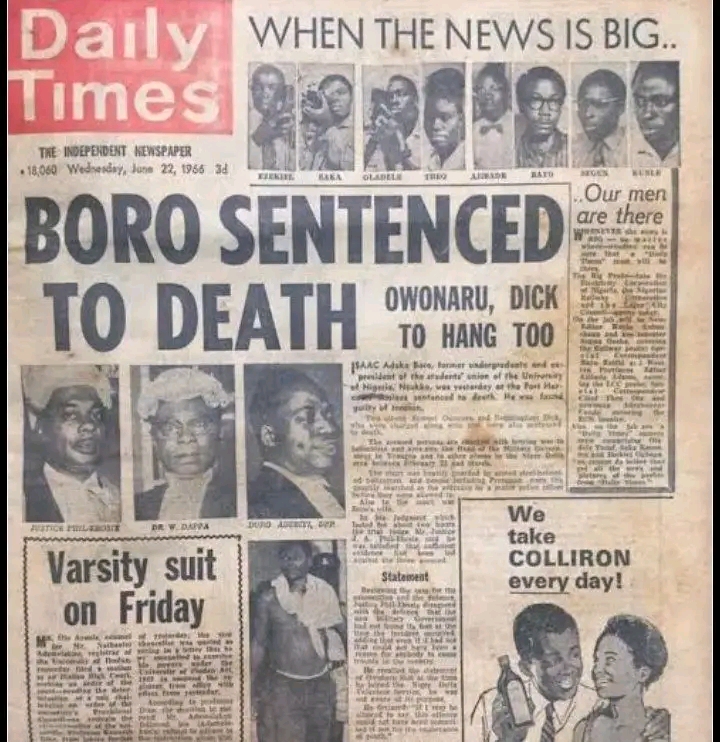

The life of Isaac Adaka Boro is more than a historical episode, it is the starting point of a struggle that remains unresolved in Nigeria today. Long before the language of “resource control” and “self-determination” became mainstream in national discourse, Boro had already taken the argument beyond words and into action.
As a student leader at the University of Nigeria Nsukka, Boro emerged as a fierce voice for the Niger Delta, a region rich in natural resources yet plagued by neglect and underdevelopment.
But unlike later agitators who relied on political negotiation and advocacy, Boro chose confrontation.
In 1966, he declared a Niger Delta republic, man audacious attempt at self-determination that directly challenged the authority of the Nigerian state.
The so-called “Twelve-Day Revolution” collapsed almost as quickly as it began. Federal forces suppressed the uprising within less than two weeks.
The republic he proclaimed never materialized beyond symbolism, and Boro was arrested, tried, and sentenced to death under the government of Johnson Aguiyi-Ironsi.
His failure was not merely military, it exposed the structural imbalance between regional agitation and central authority in a fragile post-independence state.
Boro may have ignited the flame of self-determination in the Niger Delta, but he lacked the political, military, and institutional backing to sustain it.
Yet, history did not end with his defeat.
The 1966 Nigerian counter-coup altered the political landscape and spared Boro from execution.
Under Yakubu Gowon, he was granted amnesty in 1967 and absorbed into the Nigerian Army on the eve of the Nigerian Civil War. In a dramatic twist, the pioneer of Niger Delta self-determination would go on to fight for the very state he once sought to break away from.
This transformation raises enduring questions. Did Boro abandon his cause, or was he compelled by circumstance? Was his integration into the military a reconciliation or a co-optation?
What is clear, however, is that the core issues he raised did not disappear. If anything, they deepened.
The agitation for resource control, the demand that oil-producing communities should have greater ownership and benefit from their resources, has since evolved into one of Nigeria’s most persistent political challenges.
From militant movements to political restructuring debates, the echoes of Boro’s failed republic can still be heard. He was, undeniably, a pioneer, perhaps ahead of his time. But being first is not the same as being successful.
Boro died during the civil war while serving under Benjamin Adekunle, leaving behind a legacy marked by both defiance and contradiction.
His initial burial at the military section of the Ikoyi Cemetery, and later reinterment in Bayelsa by Seriake Dickson, mirrors the dual identity he carried in life: rebel and patriot.
Today, the struggle for self-determination and resource control continues, carried by new actors using different methods. But the foundation remains the same.
Isaac Adaka Boro may not have achieved the republic he declared, but he defined the terms of the conversation.
And until those demands are meaningfully addressed, his short-lived revolution will remain not a failed dream but an unfinished one.
