
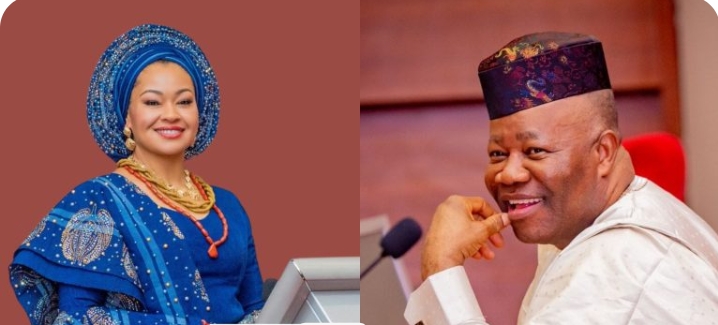

The legal battle surrounding the suspension of Senator Natasha Akpoti-Uduaghan, who represents Kogi Central Senatorial District, has taken a fresh turn as Senate President Godswill Akpabio has approached the Supreme Court to challenge appellate decisions linked to the controversy.
Akpabio, acting in his capacity as President of the Senate, has filed a motion before the apex court seeking to regularise and sustain his appeal over the disciplinary action taken against the Kogi lawmaker.
The development has further intensified national debate on legislative discipline, constitutional rights, parliamentary privilege, and the limits of judicial intervention in legislative affairs.
The suit, filed at the Supreme Court in Abuja, lists Akpabio as the appellant, while the respondents include Senator Natasha Akpoti-Uduaghan; the Clerk of the National Assembly; the Senate of the Federal Republic of Nigeria; and the Chairman of the Senate Committee on Ethics, Privileges and Public Petitions, Senator Neda Imasuen.
The appeal follows a series of legal setbacks at lower courts arising from Akpoti-Uduaghan’s suspension from Senate proceedings.
The dispute dates back to a Senate plenary session in February 2025, during which Akpoti-Uduaghan raised issues bordering on parliamentary privilege and alleged procedural irregularities. Her conduct was subsequently referred to the Senate Committee on Ethics, Privileges and Public Petitions, a process that resulted in her suspension from legislative duties.
Dissatisfied with the decision, the senator approached the Federal High Court in Abuja, arguing that her suspension violated her constitutional right to fair hearing and breached the Senate Standing Orders.
In a judgment delivered on July 4, 2025, the trial court examined issues relating to parliamentary privilege, internal legislative procedures, and the extent to which courts can intervene in the affairs of the legislature. Subsequent developments at the Court of Appeal paved the way for the matter to reach the Supreme Court.
In his application, Akpabio is seeking an extension of time to apply for leave to appeal, leave to appeal on grounds of mixed law and fact, and an order deeming his notice of appeal and brief of argument as properly filed and served.
The motion was brought pursuant to the Supreme Court Rules, the Supreme Court Act, and relevant provisions of the 1999 Constitution (as amended).
Akpabio’s legal team argued that the appeal raises substantial constitutional and procedural questions deserving the attention of the apex court. They contended that the Senate acted within its powers under Section 60 of the Constitution, which allows the National Assembly to regulate its own procedure.
According to the appellant, the presiding officer of the Senate is not obligated to rule immediately on every point of privilege raised, and that the Senate lawfully activated its internal disciplinary mechanisms in response to what it described as disorderly conduct during plenary.
However, Akpoti-Uduaghan has consistently maintained that her suspension was unlawful, excessive, and carried out in violation of her right to fair hearing. She argued that the Senate failed to comply with its own Standing Orders before referring her case to the ethics committee and imposing disciplinary sanctions.
Meanwhile, on Wednesday, January 21, 2026, Akpoti-Uduaghan’s legal team was formally served with the Supreme Court processes, effectively bringing all parties before the apex court.
The case also involves a related contempt proceeding arising from a social media post allegedly made by the senator during the pendency of the suit. The Federal High Court ruled that the post violated a subsisting restraining order, imposed a fine, and directed her to issue a public apology.
Akpoti-Uduaghan has also appealed that decision, arguing that the alleged contempt was criminal in nature and required strict compliance with statutory procedures.
The outcome of the Supreme Court proceedings is expected to set a significant precedent on the balance between legislative authority and judicial oversight in Nigeria’s democratic system.
