
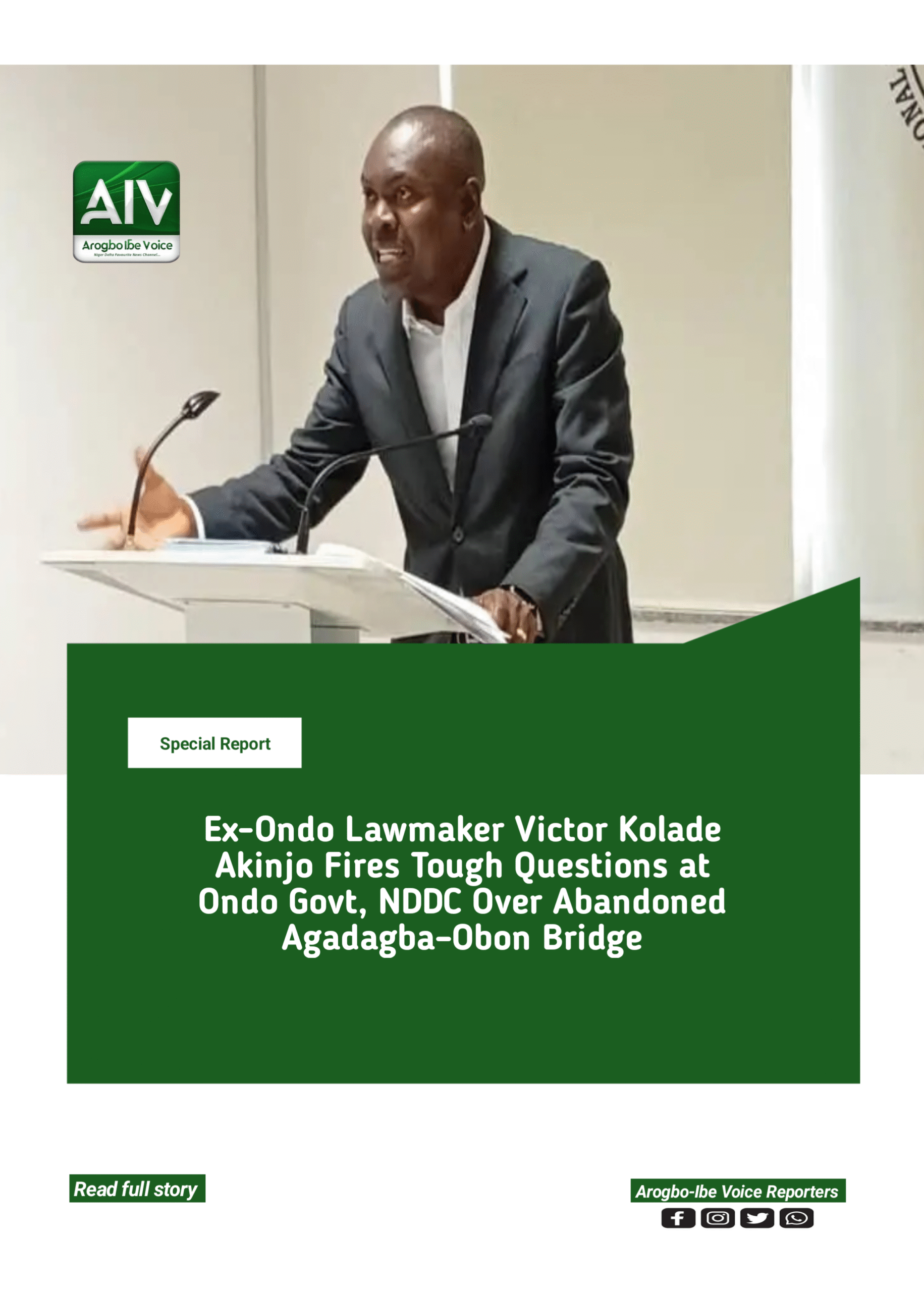
Ex-Ondo Lawmaker Victor Kolade Akinjo Fires Tough Questions at Ondo Govt, NDDC Over Abandoned Agadagba–Obon Bridge

Former member of the House of Representatives for Ilaje/Ese-Odo Federal Constituency, Victor Kolade Akinjo, has called for urgent public discourse and policy engagement over the abandoned Agadagba–Obon Link Bridge project and the broader issue of infrastructural neglect in the Ijaw riverine communities of Ondo State.
Akinjo, who described the intervention as part of his emerging focus on developmental advocacy and public accountability, said the project remains one of the most strategic but neglected infrastructure concerns affecting the oil-producing riverine axis of the state.
Speaking from the standpoint of a PhD student in Development Studies pursuing a second doctoral degree, the former lawmaker stressed that development discourse must continuously interrogate governance priorities, especially in historically marginalized communities.
According to him, the Agadagba–Obon Link Bridge possesses the potential to transform transportation, economic activities, social integration, and access to opportunities across several Ijaw riverine settlements. He, however, lamented that despite the strategic importance of the project, it appears abandoned, thereby deepening concerns among residents and stakeholders.
Akinjo consequently raised a series of critical questions aimed at stimulating public reflection, policy responsiveness, and institutional accountability.
Among the issues raised were the exact jurisdiction and location of the Agadagba–Obon road and bridge corridor, the administration responsible for constructing the tarred road leading to the river bank, and the circumstances surrounding the alleged abandonment of the bridge project previously linked to the Niger Delta Development Commission (NDDC).
The former federal lawmaker questioned why a project considered vital to vulnerable riverine communities should be left uncompleted without visible accountability mechanisms or public explanation.
He also challenged the Ondo State Government to clarify whether, given the significant revenues and allocations accruing to oil-producing states, the bridge project could be undertaken as a legacy intervention capable of improving the living conditions of the Ijaw people.
Akinjo further queried whether alternative projects of equal socioeconomic importance had been designed for the affected communities if the bridge project was no longer regarded as a priority.
Drawing comparisons with oil-producing states such as Bayelsa State, Delta State, and Rivers State, he noted that several large-scale bridge and riverine infrastructure projects had been successfully executed in those states through deliberate policy choices, political will, and strategic funding commitments.
He therefore urged policymakers, development agencies, traditional institutions, community leaders, civil society organizations, and citizens within the affected riverine areas to intensify advocacy and demand greater developmental attention for neglected communities.
According to Akinjo, the conversation should not be seen as an attempt to apportion blame, but rather as a constructive effort to promote inclusive development, infrastructural justice, equitable governance, and sustainable progress for underserved populations in Ondo State.
He added that the intervention marks the beginning of a broader series of developmental engagements intended to provoke policy conversations and encourage practical solutions to longstanding challenges confronting riverine communities.